
1 May 2026
- adpessala
- May 1
- 5 min read
On Tuesday I went to Quarry Bank, a National Trust site in the village of Styal about a thirty minute train ride from home. Most National Trust properties are stately homes where you don't get much of a sense of the lives of ordinary people other than maybe a few tidbits about the servants. It's very easy to get sucked into the romance of that world (not too far from ours, if you look at the list of property owners in Britain today and compare it with the names of people who came over with William the Conqueror). QB was one of the most interesting historic sites I've visited here because it has nothing to do with that. The property includes a textile mill where fabrics are still produced on nineteenth century machinery, the Apprentice House where some of the the mill's staff (children between 9 and 21) lived, the mill owner's house, and some gardens. From the station I followed signs for the ten minute walk to the complex.

Going into the Apprentice House required joining a tour (included in admission) led by a historical interpreter in Regency dress. She was Australian and, unlike the interpreters at Plimouth Plantation, did not attempt to speak in a period English accent which I appreciated. I'm not sure I could clock an Australian trying to fake an English accent, but I have to imagine the effort would detract from the other aspects of the duties. A few minutes into her introduction, we heard an enormous clatter above us as the school children on the upper floor moved on. It sounded like billiard balls being dropped on the roof. But it was certainly authentic to the building's origins so I saw it as a feature, not a bug.

Speaking of bugs, we learned about the staple food (porridge left to sit in a drawer until it set, then sliced and plopped directly into the kid's hand) and health remedies employed if one of them got sick. Leeches, yes, we all know about that from the olden times, thank goodness we're past all that! Or? These are RETIRED NHS LEECHES (her phrase, to be etched evermore into my brain) that are used today promoting circulation for patients who had to have fingers reattached. These leeches below had put in their service, and now get to spend their sunset years being leered at by visitors.


Above, there were two dormitory rooms that would have been single sex- the workforce was about 60% girls who were considered more "biddable"- and each bed would have been shared by two kids. Although the mill owner was considered enlightened in the matter of employee treatment and many of the kids had come there from even bleaker London workhouses, it was a hard life of long days and lots of rules. The guide told us about a boy who had been punished with 60 hours of unpaid overtime for apple scrumping. "A harsh punishment you might think if you've ever done it! Who here has ever been apple scrumping?". Just as the guide said that, I raised my hand for a brief moment of stolen valor for having done something mischievous, but I just wanted to ask what apple scrumping is. (It's taking apples). A woman in our group looked sorrowfully at the beds and said "Oh, just imagining my grandchildren in this!". I felt the mattress and it was much sturdier than the flimsy Ikea mattresses my children have been complaining about with increasing volume. Something to think about.

Compared to the Apprentice House, there wasn't much to see in the home where the Greg family who owned the mill had lived. The original furnishings were long gone and the house itself was simple. Only a few rooms are open, but the docent showed me photos on his iPad of the dreary seventies bathroom upstairs and the creepy stone corridors in the basement. In the dining room there was a multimedia exhibit playing recordings of hypothetical conversations that may have occured between the family and some of the guests who came to the house over the years, including John Jay Audobon who is also responsible for the portrait of George Washington that once hung over the fireplace. Now there is a copy of the painting, donated by the American Astra Zeneca executive who had rented the house before it was donated to the National Trust. I've now seen several historic sites that use animated silhouettes in these displays. The Tower of London's were great, with a creepy Edward Gorey feel. I can't say I was deeply moved by this one, although with so little original material or architectural distinction in the house they don't have a ton to work with.

Spinning machines and looms are still being used onsite in the mill today, and you can buy yarn, dish towels, and fabric by the yard produced on them in the gift shop. A guide turned on two of the looms. The racket was immense and the floor shook. Some of the workrooms have been shifted around, and the looms have been moved to this second floor room today where only a few can be used at a time or they could shake apart the whole building. In their original spot, there would have been up to three hundred going at the same time.

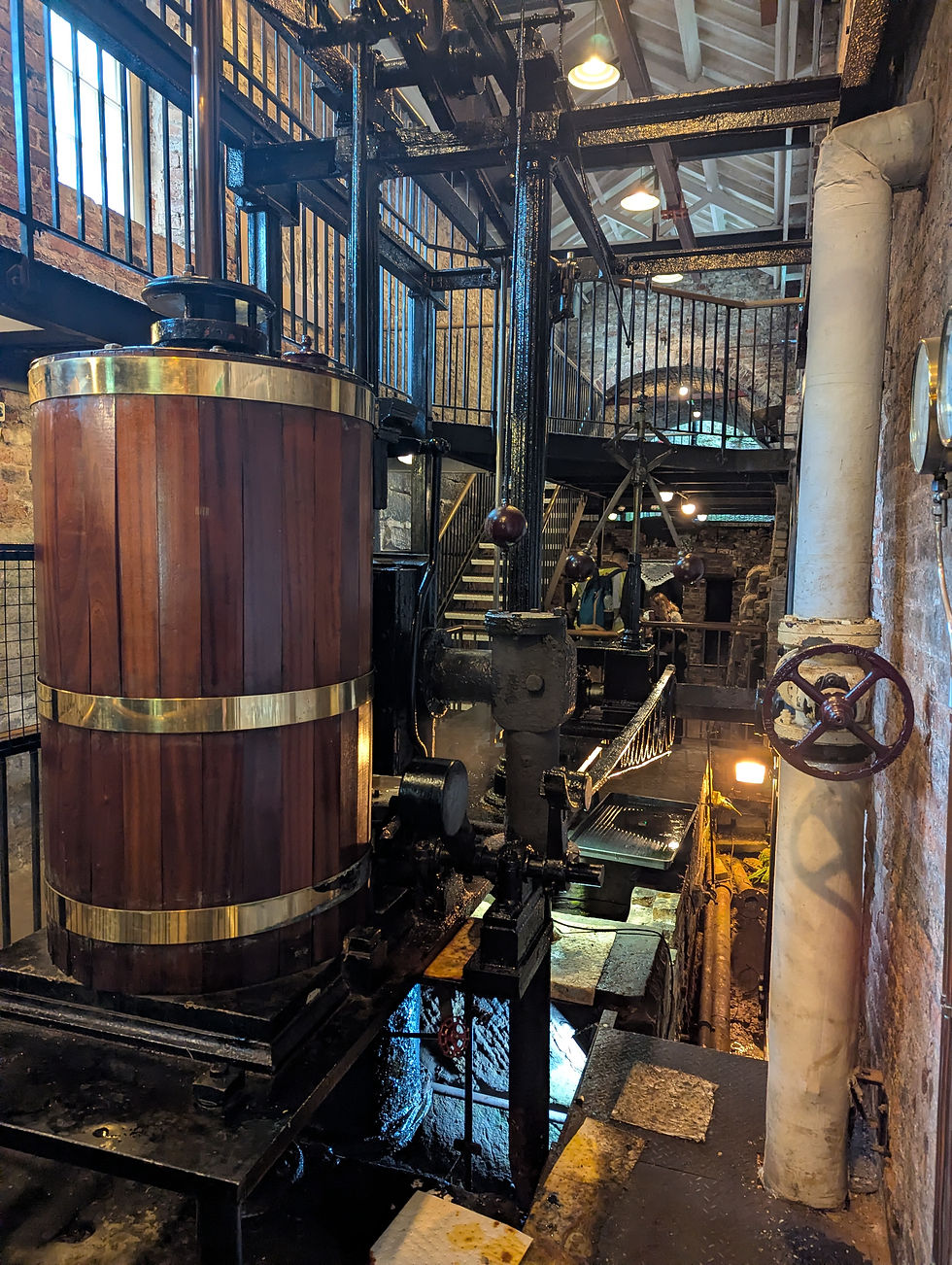
In the mill, the steam and water power mechanics are still running. I am no closer to understanding how they function than I was before, and I don't know which kinds of works were original to the factory in the late 1700s or which were introduced later before they closed. You did get a sense of how alien and hulking they would have been at the time, and how disorienting it might have felt to experience the Industrial Revolution in the moment.

There were several school groups visiting on the day I was there, and I know my kids would have been much more engaged in QB than in the rooms full of Gainsboroughs I usually drag them through. I was totally turned around in the parking lot when it was time to head home so a guide pointed me down a quiet lane where I wouldn't have to walk on the narrow shoulder by the main road. I encountered a gate with a complicated latch when I got to the edge of the mill complex, and a man coming down the path had to help me. I started to close the gate behind me and he motioned that he himself needed to pass through the gate as well, making a bemused Uncle face I seem to elicit often. On the train back I compared notes with H who I'd met on the tour. She comes from Lincoln to Manchester once a week to help with school pickup for her grandchildren, who we discovered live a block away from us. She has time to kill while they're at school and I'd just signed up for a National Trust membership so we agreed to meet up for another field trip before the school year is over.


Comments